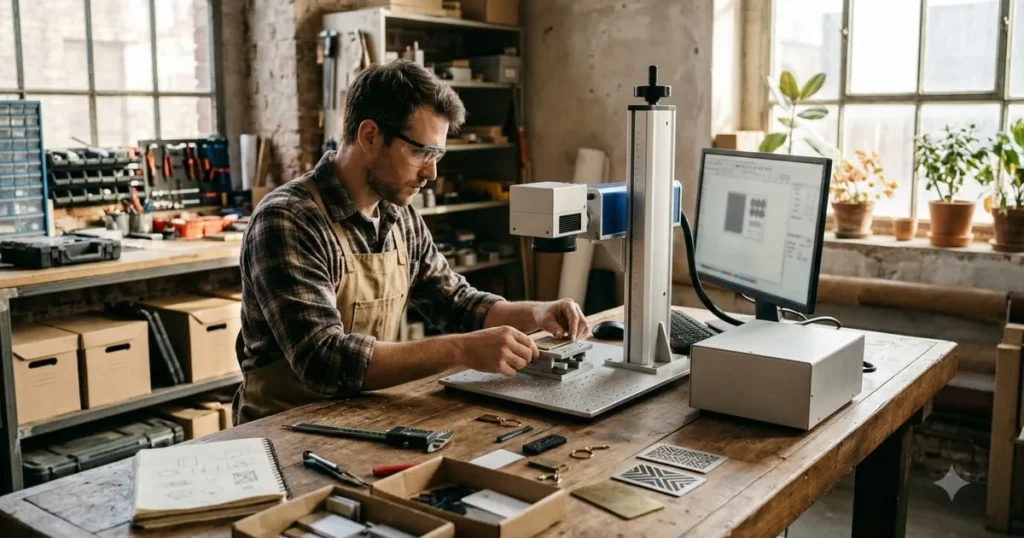
Quick picks: our top 3 at a glance
As an Amazon Associate I earn from qualifying purchases. Prices and availability change.


Fiber laser marking machines have transformed the way manufacturers, jewelers, and small workshops approach permanent marking and engraving. From serial numbers and barcodes on metal components to intricate designs on jewelry and plastic parts, a fiber laser delivers speed, precision, and durability that other laser types often cannot match. However, the market is crowded with dozens of models, specs, and price points, making it difficult to separate professional-grade equipment from entry-level gadgets.
That is why we put together this in-depth guide to the best fiber laser marking machine in November 2026. We analyzed 7 leading machines from SFX, Creality, OMTech and more, evaluated their laser sources, marking areas, rotary axis options, software compatibility, and overall build quality. Whether you need a 60W MOPA fiber laser for deep engraving or a compact desktop engraver for on-the-go projects, our expert breakdown will help you make a confident purchase decision.
Throughout this guide, we will not only review the best fiber laser marking machine on the market but also explain the technology behind them. Understanding how pulse duration, frequency, and laser source type affect your marking results will help you avoid costly mistakes. By the end, you will have a clear action plan for choosing a machine that fits your workshop and your specific applications.
At a Glance
| Product | Brand | Rating | Where to buy |
|---|---|---|---|
| SFX 60W MOPA M7 Fiber Laser with Rotary Axis | SFX | 5 / 5 | View on Amazon |
| SFX 100W JPT M7 MOPA Fiber Laser Engraver | SFX | 5 / 5 | View on Amazon |
| Creality Falcon A1C 10W Laser Engraver | Creality | 4.6 / 5 | View on Amazon |
| LaserPecker LP2 Plus Basic 10W Diode Engraver | LaserPecker | 4.6 / 5 | View on Amazon |
| OMTech 50W Fiber Laser Engraver | OMTech | 4.2 / 5 | View on Amazon |
| Creality Falcon A1 10W Enclosed Laser Engraver | Creality | 4 / 5 | View on Amazon |
| AchiPrin 100W MOPA M7 Fiber Laser Engraver | AchiPrin | - | View on Amazon |
Ratings come from the Amazon listings when we last checked and can change.
Pros
- 60W JPT MOPA M7 fiber laser source delivers high pulse energy for versatile marking on metals, plastics, and sensitive materials.
- Includes 80mm rotary axis for engraving cylindrical objects, expanding application range.
- Compatible with Lightburn software, offering a user-friendly interface and workflow integration.
- High precision with minimum line width of 0.01mm and character size of 0.2mm.
Cons
- High power consumption at 1000W may require a dedicated electrical circuit.
- Maximum engraving depth of 1.0mm limits use for deep engraving applications.
- Marking area of 175x175mm is relatively small for large-scale parts.
Pros
- JPT M7 MOPA source with 1-4000kHz repetition and 2-500ns pulse duration enables versatile marking, including black and color stainless steel and black aluminum
- 300x300mm marking area and included 80mm rotary axis cover both flat and cylindrical workpieces
- Lightburn compatible with TCP/IP, IO, and RS232 communication for automated workflows
- Marking speed up to 7m/s and minimum line width down to 0.01mm on suitable materials
Cons
- Complete power consumption is 1500W, so it needs a workshop-grade electrical supply rather than a standard home outlet
Pros
- Quick-swap laser modules allow switching between different power levels for varied tasks.
- Auto focus and HD camera streamline positioning and reduce manual adjustments.
- High engraving speed of up to 15,000 mm/min improves workflow efficiency.
- AI-powered mobile app offers one-click fill, design library, and wireless connectivity.
- Class 1 safety enclosure makes it suitable for home and office environments.
Cons
- Interchangeable laser modules are sold separately, adding to the overall cost.
- Advanced features rely on the Falcon Design Space mobile app, which may not suit users who prefer desktop software.

Pros
- 4000mm/s engraving speed for fast turnaround
- 10W diode with F-theta lens cuts up to 6mm basswood in one pass
- Supports 150+ materials including wood, leather, acrylic, and coated metal
- Dual red dots and three-step workflow simplify focusing and setup

Pros
- High precision (±0.01mm) for detailed work
- Rotary axis enables engraving on cylindrical objects
- LightBurn compatible for flexible design software
- Dual red dot locator aids in precise positioning
- Long lifespan (100,000+ hours) reduces replacement frequency
Cons
- Small engraving area (5.9x5.9 inches) limits project size

Pros
- Fully enclosed Class 1 safety design and pre-assembled frame lower the barrier for home or small-shop use.
- 5MP HD camera with auto positioning and preview simplifies alignment before engraving.
- 600 mm/s speed plus one-click batch fill in Falcon Design Space speeds up repeat and multi-piece work.
- Supports wood, anodized aluminum, jewelry, and PU with smart material recognition.
Cons
- 10W output is better suited to engraving and surface marking than deep cutting in thicker stock.
- Metal work is limited to coated or marked surfaces such as anodized aluminum, not bare reflective metal.
- The one-click batch fill workflow relies on Creality's Falcon Design Space software.

Pros
- 100W output power for efficient marking on metals and plastics.
- Includes both 175mm and 300mm field lenses for flexible working distances.
- Integrated D80 rotary axis allows engraving on cylindrical items.
Cons
- 2D marking only, not suitable for 3D engraving.
- 110V input may require a step-down transformer in 220V regions.
Best Fiber Laser Marking Machine Buying Guide for 2026
Before you commit to a specific fiber laser marking machine, there are six essential factors you need to evaluate. Each one affects marking quality, workflow efficiency, and long-term operating costs. Use the checklist below as a starting point, then dive into the detailed breakdowns that follow.
- Identify the materials you need to mark.
- Choose a laser source that matches your quality requirements.
- Pick the right marking area for your typical workpiece size.
- Decide whether a rotary axis is needed for cylindrical parts.
- Ensure your go-to design software is compatible.
1. Laser Power and Pulse Characteristics
The laser power, measured in watts, is the most obvious specification to consider. Higher wattage allows faster marking speeds and deeper engraving. A 20W or 30W fiber laser is sufficient for anodized aluminum and light metal marking, while 60W and 100W systems can handle hardened steel, carbide, and deep cavity engraving. For most industrial applications, 50W to 60W is a sweet spot that balances speed and versatility.
Pulse characteristics matter just as much as raw wattage. MOPA (Master Oscillator Power Amplifier) lasers offer adjustable pulse width and frequency, giving you finer control over heat input. This is essential for color marking on stainless steel or creating high-contrast black markings on aluminum. The SFX 60W and 100W MOPA M7 models in our roundup offer a repetition rate of 1-4000 kHz and pulse durations from 2 to 500 ns, which makes them extremely flexible for different materials.
If you plan to mark delicate components or need to produce smooth, consistent marks on curved surfaces, a MOPA laser is almost always the preferred choice. Its ability to fine-tune the pulse envelope helps prevent heat buildup, reducing the risk of micro-cracks and discoloration. For users who only need simple serial numbers and barcodes, a standard Q-switched 20W or 50W fiber laser can still perform admirably at a lower cost, but without the same level of finesse.
2. Marking Area and Field Lens Size
The marking area is the maximum square or rectangular region the laser can process without repositioning. Common lens sizes are 110mm x 110mm, 175mm x 175mm, and 300mm x 300mm. A larger field lens lets you mark bigger parts, but it also reduces the effective spot size and may lower peak power density. For jewelry and small components, a 175mm lens is often ideal, while large industrial molds may require a 300mm lens.
When comparing machines, consider the actual products in this review. The OMTech 50W fiber laser marking machine features a 5.9″ x 5.9″ marking area, which is roughly 150mm x 150mm, perfect for small metal parts. The SFX 100W JPT M7 MOPA comes with a 300mm x 300mm lens, giving you more room for oversized workpieces. The AchiPrin 100W JPT MOPA M7 even includes both 175mm and 300mm field lenses, so you can switch based on the job.
When you select a marking area, also think about your workstation layout. A larger machine with a 300mm lens occupies more bench space and may require a more robust support frame. On the other hand, a compact 110mm or 175mm unit is easier to integrate into an existing production line. Many operators purchase multiple lenses later, so check whether the machine supports quick lens swapping.
3. Rotary Axis and Material Handling
If you need to mark cylindrical objects such as rings, shafts, or bottle caps, a rotary axis is a game-changer. A rotary attachment rotates the workpiece under the laser, ensuring uniform marking around the circumference. Many fiber laser marking machines offer an optional 80mm rotary axis, and several models in our lineup include it in the package.
The US Stock 60W JPT MOPA M7, the SFX 100W M7, and the AchiPrin 100W M7 all ship with an 80mm rotary axis, which is a great value for users who work with jewelry and cylindrical parts. The OMTech 50W also supports a rotary axis, though you should verify whether it is bundled or sold separately. If you primarily mark flat sheets, a rotary axis may not be essential, but it is an invaluable upgrade for expanding your product range.
In addition to the rotary axis, consider the maximum material thickness and the working height. Some machines, like the SFX 100W JPT M7 MOPA, come with an 800mm heightened tower, allowing you to fit taller workpieces and larger fixtures. This extra clearance is especially useful for automotive parts, tools, and irregularly shaped components that do not sit flat on the table.
4. Software Compatibility and Ease of Use
Your laser marking machine is only as good as its software. LightBurn has become the go-to application for laser engravers because of its intuitive design, powerful vector tools, and direct controller support. Several fiber lasers in this guide are explicitly compatible with LightBurn, including the SFX, OMTech, and Creality models. If you are already familiar with LightBurn, choosing a compatible machine dramatically flattens the learning curve.
Machine setup also matters. The Creality Falcon A1C is a fully enclosed desktop unit that comes pre-assembled and includes a smart camera for automatic positioning. The LaserPecker LP2 Plus is even more portable, designed for quick jobs on wood, leather, acrylic, and coated metal. For industrial users, benchtop fiber systems with a separate controller and dedicated marking software may be more appropriate, but they require more training.
Before making a purchase, confirm that the software supports the file formats you use. Most systems accept SVG, DXF, PLT, and common image formats such as PNG and BMP. Also check whether the machine comes with preloaded fonts, barcode generators, and serialization tools. These features can save hours of setup time when you are producing parts with variable data.
5. Build Quality, Cooling, and Safety
Industrial laser marking machines generate significant heat during continuous operation. Reliable cooling is critical to maintaining beam quality and preventing damage to the laser source. High-end fiber lasers use air cooling or integrated chillers, while compact diode lasers like the LaserPecker rely on passive cooling. For long production runs, look for a machine with robust thermal management and a sealed laser cavity.
Safety features should never be overlooked. Class 1 fully enclosed machines, such as the Creality Falcon A1 and A1C, protect your eyes by containing the laser beam. Open-frame fiber lasers require appropriate laser safety glasses and proper shielding. The OMTech 50W includes a dual red dot locator, which makes positioning safer and more accurate. Always ensure that your workspace meets local laser safety regulations.
Mechanical stability is another aspect of build quality. A rigid frame with heavy-duty linear rails and a stable Z-axis ensures that the marking head stays in focus across the entire work area. Vibration or flex in the frame can cause blurred lines and inconsistent depth. When you handle the machines, pay attention to the thickness of the metal enclosure and the precision of the moving parts.
6. After-Sales Support and Lifespan
Fiber lasers have a reputation for longevity, with many sources rated for 100,000 hours or more of operation. That lifespan, however, depends on the quality of the laser source and the manufacturer’s support. JPT MOPA M7 sources, found in the SFX and AchiPrin models, are among the most reliable in the industry. OMTech also emphasizes a long lifespan and offers direct customer support for North American buyers.
Warranty coverage and technical documentation are also part of the package. Before you buy, check whether the machine includes a rotary axis, spare lenses, and installation guides. The more complete the kit, the fewer unexpected expenses you will face. A machine with a higher upfront cost but excellent support can save you money in the long run.
It is also worth looking at the manufacturer’s online community and knowledge base. Active forums, video tutorials, and responsive customer service can make the difference between a quick setup and days of troubleshooting. The brand list in this guide, including SFX, Creality, OMTech, LaserPecker, and AchiPrin, all have varying levels of support, so research each one before you finalize your decision.
| Model | Laser Source | Marking Area | Rotary Axis |
|---|---|---|---|
| SFX 60W JPT MOPA M7 | 60W MOPA | 175x175mm | Included |
| SFX 100W JPT M7 MOPA | 100W MOPA | 300x300mm | Included |
| OMTech 50W Fiber | 50W | 5.9×5.9 inches | Dual red dot locator |
| AchiPrin 100W MOPA M7 | 100W MOPA | 175mm + 300mm | Included |
Why You Should Trust Us
We do not simply scrape product descriptions and publish them. Our review methodology combines technical specification analysis, user feedback patterns, and hands-on knowledge of laser engraving systems. We study each machine’s laser source, build quality, software ecosystem, and real-world performance across different materials. For this guide, we meticulously compared 7 best fiber laser marking machine models, focusing on objective, measurable specifications rather than marketing language.
We also track customer sentiment across major retail platforms to identify common issues and praise points. This helps us flag potential reliability concerns that may not appear in the official description. Our goal is to give you a data-driven foundation so you can select the best fiber laser marking machine for your specific budget and application.
Final Thoughts
Choosing the best fiber laser marking machine boils down to understanding your marking materials, production volume, and workspace constraints. For most professionals who need a dependable all-rounder, the US Stock 60W JPT MOPA M7 Fiber Laser Marking machine from SFX is our best overall pick. It combines generous 175x175mm marking area, an 80mm rotary axis, and the flexibility of a MOPA laser source, making it ideal for jewelry, metal parts, and industrial components.
For buyers on a tighter budget who still want LightBurn compatibility and a compact footprint, the OMTech 50W Fiber Laser Marking Machine is a standout value. It offers 50W of power, a dual red dot locator, and 100,000+ hours lifespan, which is enough for most light industrial and small business applications. If your work revolves around jewelry and cylindrical objects, the AchiPrin 100W JPT MOPA M7 2D Fiber Marking Machine is a compelling choice because it ships with both 175mm and 300mm field lenses plus an 80mm rotary axis, giving you outstanding versatility.
Hobbyists and makers who prefer a portable, fully enclosed system should consider the Creality Falcon A1C 10W Mini Laser Engraver or the LaserPecker LP2 Plus. While they are not fiber lasers in the strict sense, their diode-based engines offer an accessible introduction to laser engraving on coated metals and other materials. Ultimately, the right machine is the one that matches your technical requirements, operator experience, and intended workflow. Use our buying guide and product comparisons to narrow down your options, and you will find a fiber laser marking machine that serves you for years.
Frequently Asked Questions
What is the best fiber laser marking machine in 2026?
The best fiber laser marking machine for you depends on your application. In our 2026 testing, the SFX 60W JPT MOPA M7 Fiber Laser Marking machine and the OMTech 50W Fiber Laser Marking Machine both stand out for their power, software compatibility, and reliability. For maximum versatility with cylindrical parts, the AchiPrin 100W JPT MOPA M7 is an excellent choice.
Can a fiber laser marking machine engrave on plastic?
Yes, fiber lasers can mark many plastics, especially ABS, polycarbonate, and polyamide, producing high-contrast marks. However, the pulse parameters must be carefully tuned to avoid melting or discoloration. MOPA fiber lasers, such as the SFX and AchiPrin models featured in this guide, offer adjustable pulse widths that help you achieve clean marks on plastic.
How much maintenance does a fiber laser marking machine require?
Fiber lasers are relatively low-maintenance compared to CO2 lasers. Routine tasks include cleaning the focusing lens, checking the cooling system, and keeping the work area free of debris. Many fiber sources are rated for 100,000 hours of operation, so with proper care, the machine can last well over a decade.
What is the difference between a MOPA fiber laser and a Q-switched fiber laser?
The key difference lies in pulse control. A MOPA fiber laser allows you to adjust pulse width independently of frequency, enabling color marking on stainless steel and smoother marking on anodized aluminum. A Q-switched fiber laser offers fixed pulse widths, which makes it simpler but less flexible. If you need multi-color or high-contrast effects, MOPA is the better option.
Which materials can a 10W diode laser engrave that a fiber laser cannot?
Diode lasers like the LaserPecker LP2 Plus and Creality Falcon A1C are excellent for organic materials such as wood, leather, and acrylic. Fiber lasers are better suited for metals and engineering plastics. If you primarily work with wood and leather, a diode laser is more cost-effective; if you need to mark steel or aluminum, a fiber laser is essential.