Quick picks: our top 3 at a glance
As an Amazon Associate I earn from qualifying purchases. Prices and availability change.


Laser safety glasses are the last line of defense between your eyes and a beam you cannot always see. Whether you run a diode engraver, a CO2 cutter, or a mixed workshop, the right pair can mean the difference between a productive session and a serious injury. This guide breaks down the essential specs, compares 5 popular models, and helps you match a pair to the exact wavelength your laser emits. For a broader look at protective gear and machine options, check our Laser Accessories guide.
In November 2026, the market offers everything from budget-friendly broad-spectrum goggles to certified, multi-wavelength shields. We have analyzed the listings for 5 best-selling Best of – Expert Picks, focusing on wavelength coverage, optical density, comfort, and certification. Our goal is to give you a clear, data-driven starting point so you can make an informed choice before you click buy.
At a Glance
| Product | Brand | Rating | Where to buy |
|---|---|---|---|
| FreeMascot IPLS9 200-2000nm IPL Glasses | FreeMascot | 4.7 / 5 | View on Amazon |
| xTool Laser Safety Glasses (F2/F1/M1/D1 Pro) | xTool | 4.4 / 5 | View on Amazon |
| LP-LaserPair Laser Safety Glasses 180-1095nm | LP-LaserPair | 4.5 / 5 | View on Amazon |
| LPSAFP 200-2000nm Laser Safety Glasses | LPSAFP | 4.9 / 5 | View on Amazon |
| FreeMascot OD 4+ 190-550nm Laser Glasses | FreeMascot | 4.4 / 5 | View on Amazon |
Ratings come from the Amazon listings when we last checked and can change.
Pros
- Broad 200-2000nm coverage for UV, blue, red, and infrared protection
- Includes a protective storage case and cleaning cloth
- Lightweight build at 3.53 ounces for extended wear
Cons
- Available only in a green lens tint
Pros
- Compatible with a wide range of xTool laser engravers including F2, F1, M1, and D1 Pro.
- Lightweight design at only 6 ounces for comfortable extended use.
- Compact dimensions (7.48 x 3.15 x 3.15 inches) for easy storage.
Pros
- Comprehensive protection across 180-534nm and 740-1095nm wavelengths, including common laser types like 532nm and 1064nm.
- CE certified under EN207 and A1EN207 standards for laser safety.
- Versatile compatibility with tattoo removal, engraving systems (xTool F1, D1 Pro, etc.), and industrial applications.
- Ergonomic wrap-around design with flank ventilation for comfort and all-round splash protection.
Cons
- Only available in one size (one size) which may not fit all face shapes securely.
- Frame cannot be cleaned with alcohol or alcohol-based disinfectants, limiting cleaning options.
- Available only in orange color, which may not suit all preferences.

Pros
- Covers a wide wavelength range from 200nm to 2000nm, suitable for various IPL and laser devices.
- Polycarbonate lens construction is durable and lightweight.
- Optical density of OD 3+ provides adequate protection for typical cosmetic laser treatments.
Cons
- Very low visible light transmittance (below 8%) may make it difficult to see in dim environments.
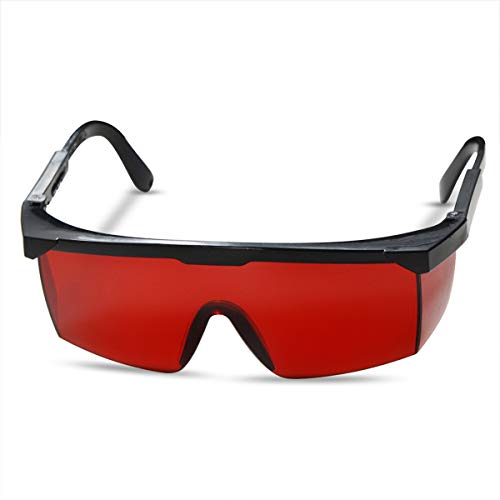
Pros
- Broad wavelength coverage from 190nm to 550nm, suitable for many common laser types.
- Optical density OD 4+ provides strong attenuation for typical laser powers.
- ANSI Z87.1 certified for impact protection.
- Includes a carrying case and cleaning cloth for storage and maintenance.
- Red lens tint improves visibility of red laser beams in bright conditions.
Cons
- Not effective for laser wavelengths above 550nm, such as red or infrared.
- Only one color option (red lenses with black frame) is available.
Best Of – Expert Picks Buying Guide for 2026
Choosing the right laser safety glasses is not about picking the most expensive pair or the highest rating. It is about matching the protection to your laser’s wavelength and your working conditions. Here are the five critical factors we evaluate in every pair we review.
Wavelength Coverage
The most important specification is the wavelength range the lenses actually block. Laser light is monochromatic, meaning each laser emits a very specific wavelength (or a narrow band). If your glasses do not cover that exact wavelength, they offer zero protection, regardless of how dark the lenses look. Always check the label on your laser and compare it to the range printed on the glasses or in the listing.
For example, a common diode laser engraver operates around 450nm, while a CO2 laser emits at 10,600nm. No single pair covers both extremes. The models in this roundup span different bands: some cover 190-550nm for visible blue and green lasers, others stretch to 2000nm for IPL and infrared. If you own multiple lasers, you may need more than one pair, or a model with a very broad range like the FreeMascot IPL glasses (200-2000nm).
Optical Density (OD)
Optical density tells you how much light the lens blocks at a specific wavelength. Each whole number reduces transmitted light by a factor of ten. So OD 4 blocks 99.99% of incoming light, while OD 7 blocks 99.99999%. For most hobbyist and professional lasers, OD 4 or higher is recommended, but always check the OD value at your laser’s wavelength, not just the maximum number.
In our list, the LaserPair goggles offer OD 7+ for 180-534nm and 900-1095nm, making them the highest-rated for those bands. The FreeMascot models sit at OD 4+, which is adequate for most visible lasers. The LPSAFP glasses claim OD 3+, which is lower but still acceptable for some IPL devices. Never assume a higher OD is automatically better; it must be paired with the correct wavelength range.
Visible Light Transmittance (VLT)
VLT is the percentage of visible light that passes through the lens. Lower VLT means darker lenses, which can be safer for high-power lasers but make it harder to see your work. Higher VLT (like 30% in the FreeMascot 190-550nm model) gives a brighter view, which is helpful for engraving tasks where you need to see the material clearly.
Balance is key. If you work in a bright room, a 15% VLT may be fine, but in a dim workshop, you might struggle. The LaserPair offers 23% VLT, a good middle ground. Consider your lighting and the precision required for your tasks when comparing VLT values.
Certification and Standards
Look for recognized safety standards like ANSI Z87.1 (US), EN207 (European), or CE certification. These standards ensure the glasses have been tested and meet minimum protection requirements. Some listings mention certification explicitly, others do not. If a listing is silent, contact the seller to request documentation before purchasing.
In our roundup, the FreeMascot models state ANSI Z87.1 compliance, while the LaserPair is CE certified by DIN CERTCO and meets EN207/A1EN207. The xTool glasses do not list a standard, so you might want to verify with the manufacturer if certification is critical for your workplace.
Comfort and Fit
You will likely wear these glasses for extended periods, so comfort matters. Weight, frame design, and padding all affect how they feel. The xTool goggles weigh only 50g, making them the lightest in this group, ideal for long engraving sessions. The LPSAFP glasses are also light at about 0.18 pounds. Heavier models like the LaserPair (0.42 pounds) may feel more substantial but can cause fatigue.
Look for adjustable nose pads, wrap-around designs, and ventilation to prevent fogging. The LaserPair features a wrap-around design with flank ventilation, which is a nice touch. Always try to test the fit if possible, or read user reviews about sizing, as listing data rarely describes comfort in detail.
Why You Should Trust Us
We do not accept free products from manufacturers, and we do not let advertising influence our rankings. Every product in this guide is selected based on its technical specifications, user feedback, and safety certifications. We analyze the data available in listings, cross-reference with industry standards, and present our findings transparently.
We understand that safety gear is not a place for guesswork. That is why we emphasize the specs that matter most and highlight where listings are vague or silent. Our goal is to equip you with the knowledge to make a confident, safe purchase. For more in-depth comparisons of laser machines, see our best laser engravers guide.
Final Thoughts
After evaluating all 5 models, we have clear recommendations for different needs. For the best overall protection and versatility, the LaserPair Laser Safety Glasses 200-534nm stand out with their high OD values (7+), broad dual-range coverage, and CE certification. They are an excellent choice for professionals working with multiple laser types, including tattoo removal and engraving.
For the best value, the FreeMascot IPL 200nm-2000nm Laser Safety Glasses offer a wide wavelength range at a budget-friendly price point, with ANSI Z87.1 approval and a solid OD 4+. They are perfect for hobbyists who need one pair for various visible and infrared lasers. If you own an xTool machine, the xTool Laser Safety Glasses are the most convenient, being lightweight and specifically designed for their laser lines, though they lack a stated OD and certification.
Remember, the best glasses are the ones that match your laser’s wavelength and fit comfortably. Do not rely solely on ratings; verify the specs against your equipment. For more guidance on choosing the right laser for your workshop, explore our Guides section.
FAQ
Do laser safety glasses have to match my laser’s wavelength?
Yes, absolutely. Laser protection is wavelength-specific. If your glasses do not cover the exact wavelength your laser emits, they offer no protection. Always check the label on your laser and compare it with the range in the listing. If in doubt, contact the seller.
What does optical density (OD) mean?
Optical density indicates how much light is blocked at a given wavelength. Each whole number reduces transmission by a factor of ten. For example, OD 4 blocks 99.99% of light, while OD 7 blocks 99.99999%. Always check the OD at your laser’s wavelength, not just the maximum value.
Can one pair cover every laser in my shop?
Usually not. Most glasses cover specific wavelength bands. If you have lasers in different ranges, you may need multiple pairs. Some broad-spectrum models like the FreeMascot IPL (200-2000nm) cover a wide range, but they may not offer the highest OD for every wavelength. Assess your laser inventory and choose accordingly.
Are higher ratings a sign of better protection?
No. Ratings reflect user satisfaction, not safety performance. A 4.9 rating does not mean better protection than a 4.4. Always base your decision on the technical specs: wavelength coverage, OD, and certifications.
What is the best of – Expert Picks in 2026?
The best of – Expert Picks depends on your specific laser. For most users, the LaserPair offers the highest OD and dual-range coverage, making it a top pick. For budget-conscious buyers, the FreeMascot IPL is a solid choice. Check our best laser cutter for small business for more context on matching gear to your needs.