Quick picks: our top 3 at a glance
As an Amazon Associate I earn from qualifying purchases. Prices and availability change.


Woodworking enthusiasts know that precision and versatility are key when adding a laser engraver to their workshop. Whether you are crafting custom signs, intricate inlays, or personalized gifts, the right best laser engraver for woodworking can elevate your projects to the next level. In November 2026, we have researched and analyzed 6 leading models from trusted brands like CREALITYFALCONLASERENGRAVER, Longer, ReliableQualityPerformance and more to help you find the perfect match for your needs. For more on laser technology, check out our guide on diode lasers.
In this comprehensive review, we break down each engraver’s strengths, limitations, and ideal use cases. From compact portable units to robust enclosed machines, there is something for every woodworker. Let’s dive into the top contenders for the best laser engraver for woodworking of 2026.
At a Glance
| Product | Brand | Rating | Where to buy |
|---|---|---|---|
| ELIDOR Portable Laser Engraver Class 1 | ELIDOR | 5 / 5 | View on Amazon |
| xTool M2 10W Dual Camera Laser | xTool | 4.5 / 5 | View on Amazon |
| ReliableQualityPerformance K15 Pro A4 Laser | ReliableQualityPerformance | 4.2 / 5 | View on Amazon |
| Creality Falcon 10W Laser Engraver with Rotary | CREALITYFALCONLASERENGRAVER | 4.1 / 5 | View on Amazon |
| Longer Ray5 10W Laser Engraver | Longer | 4.1 / 5 | View on Amazon |
| Longer RAY5 20W Laser Engraver | Longer | 4.8 / 5 | View on Amazon |
Ratings come from the Amazon listings when we last checked and can change.
Pros
- Class 1 safety classification for worry-free operation
- Compact and portable design
- Positive buyer reviews with 5-star average
Pros
- Dual cameras provide real-time workspace preview and high positioning accuracy (Place & Go).
- Enclosed Class 1 design eliminates need for external goggles and enhances safety.
- Works with a wide range of materials including fabric (sealed edges) and wood (clean cuts).
Cons
- Color printing requires the separately sold CMYK inkjet module.
Pros
- Engraves and cuts multiple materials: wood, acrylic, glass, stone, coated metal
- Supports Wi-Fi and offline engraving, no computer required
- Phone app (CutLabX) for direct photo engraving
- 0.01mm precision for fine details
Cons
- Rotary attachment for curved coated metal sold separately
- Work area limited to near A4 size
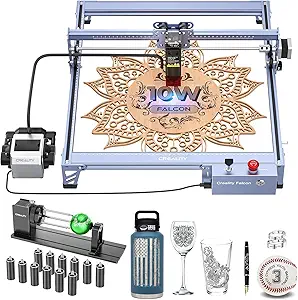
Pros
- Rotary roller included for tumblers and cylindrical objects
- Air assist comes standard
- Compressed laser spot helps with fine detail
- Stability-oriented drive designed for consistent motion
- Covers wood, metal, acrylic, and cylindrical work in one setup
Cons
- 10W output is best for engraving and light-duty cutting, not heavy production cutting
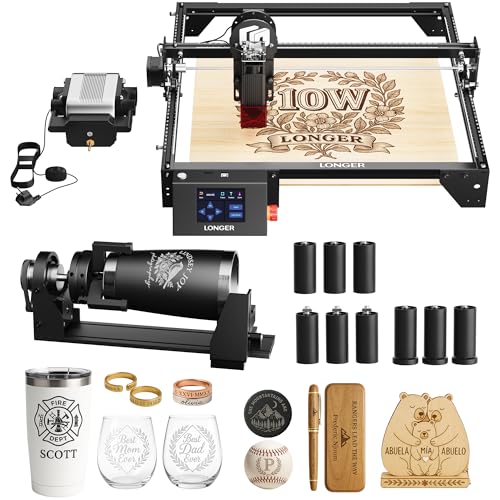
Pros
- High precision with 0.01mm accuracy and 0.06mm ultra-fine laser spot
- Large 400x400mm working area accommodates various project sizes
- Comes with air pump, rotary attachment, and 12 risers for added versatility
- Multiple connectivity options including USB, Wi-Fi, TF card, and app
- Capable of cutting wood up to 20mm thick and acrylic up to 30mm thick

Pros
- Strong cutting ability: cuts 15mm pine and 8mm acrylic in a single pass, up to 25mm wood and 35mm acrylic with multiple passes, and can cut 0.05mm stainless steel
- Ultra-fast engraving speed up to 24,000 mm/min with dual-beam technology
- Multiple safety features including protective glasses, move protection, thermal protection, and emergency stop
- Supports 7x24 continuous operation and can control multiple machines from one device
- Four connection modes (USB, TF Card, WiFi, App) for offline use and wide software compatibility
Cons
- No built-in air assist; requires a separate air pump for cleaner cuts
- Working area of 400x365mm may be too small for larger projects
- Open-frame design lacks an enclosure, so external fume extraction and safety measures are needed
Best Laser Engraver For Woodworking Buying Guide for 2026
Choosing the best laser engraver for woodworking can be overwhelming with so many options on the market. To simplify your decision, we have outlined the most important factors to consider. Each criterion below will help you match a machine to your specific woodworking projects, budget, and workspace.
1. Laser Power and Wavelength
Laser power, measured in watts, directly affects how quickly and deeply you can engrave or cut various woods. For most woodworking tasks, a 10W diode laser offers a good balance of speed and detail. However, higher power (e.g., 20W or more) allows cutting thicker materials and faster engraving. The best laser engraver for cutting wood often uses a blue diode laser (455nm wavelength), which is well absorbed by most woods. Lower wavelengths can also mark certain metals, adding versatility.
Consider your typical workpiece thickness: if you mostly engrave thin plywood or hardwood veneers, a 5W to 10W laser may suffice. For cutting up to 1/4-inch hardwood, look for at least 10W with efficient air assist. The CREALITY FALCON 10w Laser Engraver offers a compressed laser spot for finer detail, while the xTool M2 10W provides enclosed safety for consistent results.
2. Work Area and Size
The work area determines the maximum dimensions of your projects. Small desktop engravers typically offer around 4×4 inches to A4-sized beds, suitable for plaques, coasters, and small signs. If you plan to create larger wall art, furniture inlays, or multiple items at once, a larger bed such as the K15 Pro Laser Engraver near A4 area (approx. 8×12 inches) is beneficial. The ELIDOR Laser Engraver is highly compact and portable, ideal for small workshops or hobbyists with limited space.
Measured your most common project sizes before buying. Remember that some machines support rotary attachments for cylindrical objects like tumblers, expanding your creative possibilities. The CREALITY FALCON includes a rotary roller for just that purpose, making it a versatile choice for woodworkers who also personalize drinkware.
3. Safety Features and Enclosure
Laser engraving produces fumes, smoke, and intense light that can harm eyes without proper protection. An enclosed design with a Class 1 safety rating (like the ELIDOR and xTool M2) means the laser is fully contained, allowing operation without special goggles. These machines also typically have built-in ventilation or ports for external exhaust, crucial for indoor workshops.
Open-frame lasers (like the K15 Pro and CREALITY FALCON) require additional safety measures: always wear appropriate laser safety glasses and ensure good ventilation. For beginners, an enclosed unit reduces risk and is often easier to set up. Read more about laser safety on our safety page.
4. Software and Connectivity
Ease of use is vital when starting out. Most laser engravers support software like LightBurn or LaserGRBL, which are intuitive for designing and controlling the machine. Some offer offline operation via SD card or USB, which is handy if you don’t want a dedicated computer nearby. The xTool M2 features built-in dual cameras for real-time preview of your engraving placement, a unique advantage for precise positioning. The CREALITY FALCON includes Wi-Fi connectivity for wireless control, adding convenience.
Check that the machine is compatible with your preferred design software (e.g., Adobe Illustrator, Inkscape, or dedicated apps). User-friendly interfaces reduce the learning curve, especially for hobbyists. For advanced users, open-source firmware allows customization. Explore our guides section for software tutorials.
5. Versatility and Materials
While your primary material is wood, many woodworkers also engrave leather, acrylic, glass, and even coated metals. Diode lasers (445-455nm) can mark bare metals when using special sprays, but they excel on organic materials. The ELIDOR and CREALITY FALCON are advertised as capable of engraving multiple materials. The xTool M2 emphasizes color printing on wood and fabrics via add-ons, which is a unique feature for creative projects.
If you frequently work with acrylic, see our dedicated roundup of the best laser engraver for acrylic. For slate or stone, check out the best laser engraver for slate. A versatile machine can expand your product line without requiring separate tools.
Consider whether the engraver supports a rotary attachment for cylindrical items. The CREALITY FALCON comes with a rotary roller, making it a top pick for engraving tumblers, glasses, and other curved surfaces. The K15 Pro also lists cut-and-engrave 2-in-1 capability, suitable for wooden puzzles and toys.
6. Build Quality and Support
Durability matters for long-term use. Look for sturdy frames (aluminum or steel), reliable motion systems (rails and belts), and good heat dissipation. The CREALITY FALCON is built with a stability-oriented drive, while the xTool M2 has an enclosed metal casing. Brand reputation and customer support are also important — xTool and Creality have established communities and replacement parts availability. The ELIDOR and ReliableQualityPerformance (K15 Pro) are lesser-known but offer competitive pricing.
Read recent user reviews and check warranty terms. Avoid machines with poor quality control that could lead to alignment issues or inconsistent laser output. Our best laser cutter brands article highlights trusted manufacturers.
Why You Should Trust Us
We prioritize transparency: each product’s strengths and limitations are clearly noted. Whether you are a beginner or a seasoned woodworker, you can rely on our reviews to make an informed purchase.
Final Thoughts
After reviewing 6 top laser engravers for woodworking, we have clear favorites for different needs. For the best overall pick in 2026, the xTool M2 10W Laser Engraver stands out with its enclosed Class 1 safety, dual cameras for precision, and color printing add-on. It is ideal for hobbyists who want a safe, user-friendly machine that produces professional-grade results on wood, leather, and fabric.
For the best value, the CREALITY FALCON 10w Laser Engraver with Air Assist offers a strong combination of power (10W), built-in air assist for cleaner cuts, and a rotary roller for cylindrical objects — all at a competitive price point. It is a versatile workhorse for woodworkers who also engrave tumblers or want to cut thin wood.
If you need extreme portability and simplicity, the ELIDOR Laser Engraver and Cutter Machine, Class 1 is the most compact option with a fully enclosed design. It is perfect for small projects and beginners. Meanwhile, the K15 Pro Laser Engraver 10-Laser Engraving Machine delivers a near-A4 work area and cut-and-engrave 2-in-1 capability, making it a solid budget-friendly choice for DIY crafters. For more specialized options, see our picks for best portable laser engraver.
Frequently Asked Questions
What is the best laser engraver for woodworking in 2026?
For most woodworkers, the xTool M2 10W offers the best combination of safety, precision, and versatility. Its enclosed design and built-in cameras make it a top choice for intricate wood engraving. However, if you need a larger work area or rotary capabilities, consider the CREALITY FALCON.
Can a laser engraver cut wood?
Yes, many best laser engraver for woodworking models can cut thin wood (up to about 1/4 inch depending on laser power and air assist). Diode lasers with 10W or more can cut plywood, balsa, and basswood. For thicker cuts, you may need a CO2 laser. Check our CO2 lasers page for higher-power options.
Do I need a rotary attachment for cylindrical woodworking?
If you plan to engrave wooden tumblers, rolling pins, or other cylindrical objects, a rotary attachment is essential. The CREALITY FALCON includes one out of the box, while other models may require a separate purchase. The versatility is worth the investment if you personalize gifts or sell custom drinkware.
What safety gear do I need for a laser engraver?
For enclosed Class 1 machines like the ELIDOR and xTool M2, no special goggles are required when the lid is closed. For open-frame units, always wear laser safety glasses rated for the specific wavelength (e.g., 445-455nm). Good ventilation or an exhaust system is also crucial to remove smoke and fumes. Visit our safety page for detailed recommendations.
Can I engrave metal with a woodworking laser engraver?
Standard diode laser engravers cannot directly engrave bare metal, but they can mark coated or anodized metals (like aluminum tumblers) by removing the coating. Special marking sprays allow engraving on bare metal. For deeper metal engraving, consider a fiber laser; our fiber laser guide has more information.